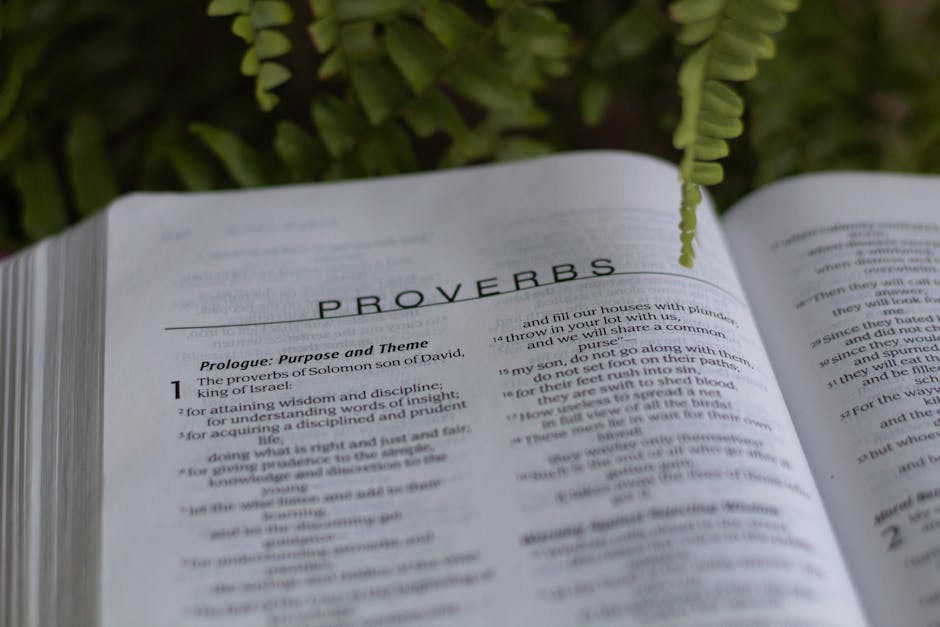
Proverbs is the Bible’s most practical book about money, and its counsel is down to earth: work hard, plan ahead, stay out of needless debt, deal honestly, give freely, and don’t wear yourself out chasing wealth. It offers not one rule but a kit of wise patterns for a stable, generous life.
Read it as wisdom, not as a vending machine
Before any single verse, you have to know what kind of book this is. Proverbs deals in wisdom, which means it describes how life generally works, not how it always works. “Lazy hands make for poverty, but diligent hands bring wealth” (Proverbs 10:4) is a reliable pattern, not an ironclad promise. Plenty of diligent people face hardship they did not earn, and Job and Ecclesiastes exist partly to keep us from flattening Proverbs into a formula.
So treat these sayings as probabilities, not guarantees. They tell you which way to lean, the way a doctor saying “exercise and you’ll likely live longer” is giving real wisdom without promising you’ll never get sick. Hold them that way and Proverbs becomes enormously useful. Turn them into a contract with God and you set yourself up for the disillusionment the prosperity gospel trades on. The whole point of wisdom is to skillfully apply truth to a complicated world—not to escape the complications.

Where these sayings came from
Proverbs is not one book written at one sitting, and knowing its shape changes how you read a verse out of it.
The book runs 915 verses across 31 chapters, assembled from several collections that announce themselves in the text. The largest and generally the oldest is 10:1-22:16, which is 375 verses of standalone sayings. A second block, chapters 25 to 29, carries its own dated superscription: “These too are proverbs of Solomon, which the officials of King Hezekiah of Judah copied” — Hezekiah reigned roughly 728 to 698 BC, some two and a half centuries after Solomon. That line is internal evidence of editorial work, preserved in the book itself.
Chapters 30 and 31 are later still, and the long opening section, chapters 1 to 9, is the most disputed — many scholars place it after the exile. Bruce Waltke’s summary in his commentary is the careful version: an anonymous final editor appended the later collections to the earlier ones, and “this final editor, the real author of the book, not of its sayings,” probably worked in the Persian or Hellenistic period.
None of that undermines the book. It explains a feature readers notice and find confusing — that Proverbs sometimes says wealth follows diligence and sometimes says the wicked prosper. It is a curated anthology of observations, not a single argument, and the tension is deliberate.
A small detail on the closing poem: the twenty-two verses of Proverbs 31:10-31 form an acrostic, each beginning with a successive letter of the Hebrew alphabet from aleph to tav, with no gaps. It is a formal composition, not a job description.
The Egyptian parallel, and a word that got changed
One section of Proverbs has a documented relative outside Israel. The Egyptian Instruction of Amenemope, composed somewhere between roughly 1300 and 1075 BC, contains a run of sayings closely paralleling Proverbs 22:17-23:11. The most complete manuscript was acquired in Thebes in 1888 and published in 1923; the German Egyptologist Adolf Erman laid out the correspondences in 1924.
That a literary connection exists is close to universally accepted. Its direction is not. The majority view holds the Hebrew section dependent on the Egyptian text; a minority argues the reverse, or that both draw on a lost common source. R. N. Whybray, who wrote the standard study of wealth and poverty in Proverbs, changed his own position on it in the 1990s.
Here is the piece that makes this concrete. Proverbs 22:20 in a modern NIV reads “thirty sayings” — which matches Amenemope’s explicitly numbered thirty chapters. But the Hebrew text as the Masoretes preserved it does not say thirty. The written consonants give one word, their own reading tradition gives another meaning “excellent things,” and “thirty” is a third reading proposed by Erman on the strength of the Egyptian parallel. That is why NASB, KJV and JPS print “excellent things” while NIV, ESV and NRSV print “thirty sayings.” The number in your Bible may be an emendation driven by a papyrus.
Diligence and work
Proverbs has no patience for laziness and a deep respect for ordinary effort. In one of its most memorable images, it sends you to the insect world: “Go to the ant, you sluggard; consider its ways and be wise. It has no commander, no overseer or ruler, yet it stores its provisions in summer and gathers its food at harvest” (Proverbs 6:6-8). The lesson is self-direction. The ant needs no boss to make it work, because it grasps that there are seasons—a time to gather and a coming time of need—and it acts on that knowledge before the need arrives.
The book keeps returning to this contrast between the diligent and the slack. “Lazy hands make for poverty, but diligent hands bring wealth” (Proverbs 10:4) is blunt about the usual direction things run. None of this glorifies overwork; it dignifies steady, responsible labor as the normal channel through which provision comes. That fits the wider biblical vision of work and stewardship, where your effort is part of how God provides.
Saving and planning
Where the ant gathers ahead of winter, Proverbs presses the same instinct on you. “The plans of the diligent lead to profit as surely as haste leads to poverty” (Proverbs 21:5). The contrast is not lazy versus busy—it is planned versus impulsive. Hasty money decisions, the ones made under pressure or excitement, tend to cost you; patient, deliberate ones tend to compound in your favor.
That patience shows up again in how wealth is built: “Dishonest money dwindles away, but whoever gathers money little by little makes it grow” (Proverbs 13:11). Notice the method—little by little. The book is quietly endorsing the slow, unglamorous path of consistent saving over the get-rich-quick fantasy. Modern readers can hear an early case for steady, long-term habits like budgeting and patient investing here, the same logic behind sound biblical stewardship. Small amounts, gathered faithfully and given time, beat windfalls you cannot keep.
Debt and co-signing
Few financial warnings in Scripture are as pointed as Proverbs on debt. “The rich rule over the poor, and the borrower is slave to the lender” (Proverbs 22:7). It is a sober observation, not a flat prohibition on ever borrowing—but it names the real cost. Debt transfers a measure of your freedom to someone else. When you owe, you serve, and your options narrow to fit the payment.
The book is especially alarmed about putting up security for someone else’s debt. “If you have put up security for your neighbor, if you have shaken hands in pledge for a stranger… go—to the point of exhaustion—and give your neighbor no rest! Allow no sleep to your eyes… Free yourself, like a gazelle from the hand of the hunter” (Proverbs 6:1-5). The urgency is striking. Proverbs is not telling you never to help anyone; it is warning that guaranteeing a loan you cannot control puts your own household at the mercy of someone else’s choices. Read alongside the broader teaching on debt from a biblical view, the counsel is consistent: borrow cautiously, escape it deliberately, and think hard before you pledge yourself for another person’s obligations.
Honest wealth and integrity
How you get money matters as much to Proverbs as how much you get. The same verse that praises slow saving opens with a warning: “Dishonest money dwindles away” (Proverbs 13:11). Wealth gained by deceit carries a kind of built-in instability; it tends not to last, and it corrodes the person who holds it.
Then comes one of the book’s most bracing trade-offs: “Better a little with righteousness than much gain with injustice” (Proverbs 16:8). Proverbs is willing to say plainly that a smaller, clean income beats a larger, dirty one—that there are sums of money not worth what you’d have to become to get them. This is wisdom with a spine. It assumes you will sometimes face a real choice between a bigger number and a clear conscience, and it tells you which to pick. That conviction runs straight into how a believer earns, runs a business, or practices values-aligned investing: integrity is not a tax on success but part of what success means.
Generosity that paradoxically enriches
Proverbs makes a claim that sounds like bad math and turns out to be deep wisdom: giving things away can leave you richer, and clutching them can leave you poorer. “One person gives freely, yet gains even more; another withholds unduly, but comes to poverty. A generous person will prosper; whoever refreshes others will be refreshed” (Proverbs 11:24-25). The picture is of an open hand that, somehow, ends up fuller than the closed fist.
It frames generosity in startling terms elsewhere too: “Whoever is kind to the poor lends to the Lord, and he will reward them for what they have done” (Proverbs 19:17). Think about that transaction—God personally guarantees your kindness to someone who cannot repay you, treating your gift to the poor as a loan made to him. That reframes giving entirely. It is not money lost; it is the safest investment in the universe, secured by God’s own character. This is the heartbeat of biblical generosity, and it explains why open-handed people so often describe their lives as full rather than depleted.
How much of Proverbs is actually about money?
Figures get thrown around here and most of them do not survive checking.
There is no peer-reviewed count of money verses in Proverbs. The one citable scholarly figure comes from R. N. Whybray, who identified 158 of the 513 sayings in the Solomonic collections as dealing with wealth and poverty — just over 30%. A narrower count, restricted to verses containing an explicit Hebrew word for wealth, riches, silver, gold, poverty or need, yields about 99 of the book’s 915 verses, roughly 11%. The honest range is somewhere between those two, depending entirely on whether you count a verse about the sluggard and the harvest as being about money.
And the familiar claim that the Bible contains “more than 2,000 verses about money” traces to a single paragraph in a 1981 magazine article — the same paragraph that produced several other figures still circulating today. It is not a scholarly count, and the parable statistics that usually accompany it have no published list behind them at all.
The point of saying so is not pedantry. Proverbs does have a great deal to say about money, and it does not need an inflated number to be worth reading. Our guides to Bible verses about investing and biblical principles for investing work from the texts themselves.
The limits of riches and Agur’s prayer
For all its respect for diligence, Proverbs refuses to make wealth the goal. “Do not wear yourself out to get rich; do not trust your own cleverness. Cast but a glance at riches, and they are gone, for they will surely sprout wings and fly off like an eagle” (Proverbs 23:4-5). It is a deliberate cold splash. Money is real but slippery, and a life spent exhausting yourself to accumulate it is chasing something that can vanish in a glance.
The book’s most balanced word on money is a prayer from a man named Agur: “Give me neither poverty nor riches, but give me only my daily bread. Otherwise, I may have too much and disown you and say, ‘Who is the Lord?’ Or I may become poor and steal, and so dishonor the name of my God” (Proverbs 30:8-9). Agur sees the spiritual danger on both ends. Too much, and he might forget God. Too little, and he might be driven to compromise. His request is for enough—a deeply countercultural prayer, and a fitting summary of the whole book’s posture toward money. Held this way, wealth keeps its place, and so does God. That settled “enough” is the same thing Scripture elsewhere calls contentment, and it may be the richest thing Proverbs has to offer.
Frequently asked questions
Does Proverbs promise that hard work always leads to wealth?
No. Proverbs gives wisdom—general patterns of how life usually works, not guarantees. “Diligent hands bring wealth” (10:4) describes the normal direction things tend to run, but the book never promises every hardworking person will be rich. Job and Ecclesiastes round out the picture by showing that the righteous sometimes suffer and the wicked sometimes prosper.
What does Proverbs say about debt and co-signing?
Proverbs warns that “the borrower is slave to the lender” (22:7)—not an outright ban on borrowing, but a sober note that debt costs you freedom. It is even more urgent about co-signing: if you’ve pledged security for someone else’s debt, Proverbs 6:1-5 tells you to free yourself from it immediately, like prey escaping a hunter.